HSE 2024/25: Scaffold Access Remains a Key Risk — How the Universal Stair Addresses It
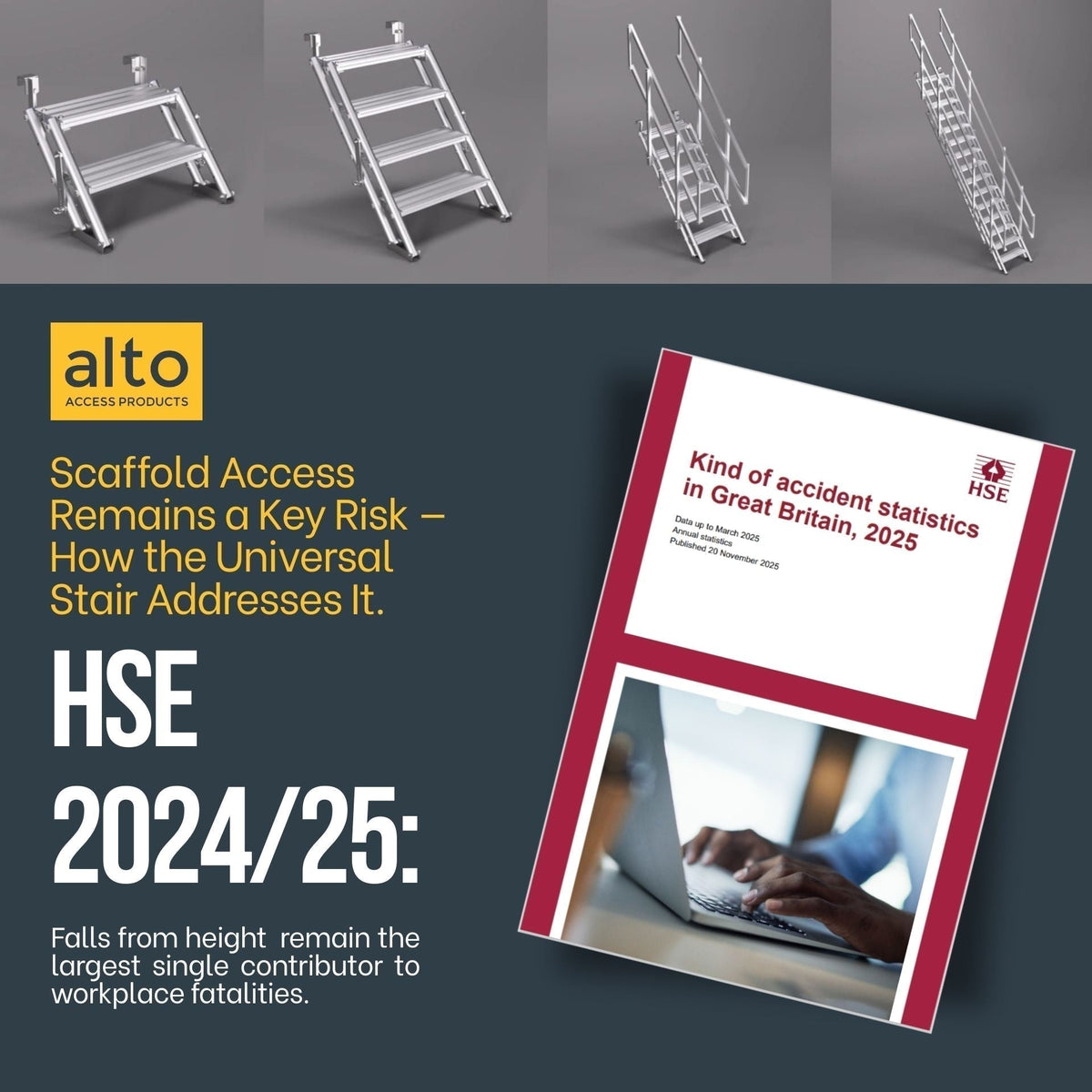
The Health and Safety Executive’s latest Kind of Accident statistics (data to March 2025) highlight that work at height continues to be a persistent hazard. Employer-reported RIDDOR incidents fell slightly to 59,219, yet 4,684 non-fatal injuries were caused by falls from height — accounting for 8% of all reported incidents, the same proportion as previous years. Falls from height also remain a the largest single contributor to workplace fatalities over the past five years.
While the report does not break down causes of falls, industry experience shows that scaffold access is a frequent point of exposure. Ladder-based access, even when correctly secured, introduces vertical instability, limits traffic flow, and makes carrying tools or components more hazardous. These operational realities align with the patterns of falls and slips highlighted in the HSE data.

See HSE Report Here
Scaffold ladder access: a known operational challenge
Although the HSE report does not break down fall-from-height causes by access method, industry experience highlights that ladder-based scaffold access carries inherent risks:
- Ladders require precise positioning and secure attachment to scaffold structures to prevent shifting or movement.
- Frequent use and repeated attachment/detachment increase the chance of variability in safety.
- Vertical climbs are inherently more challenging when carrying tools or materials, increasing exposure to slips and falls.
- Ladders create single-point access bottlenecks, which can encourage rushed movement and errors during peak periods.
These operational factors align with the accident types highlighted in the HSE report, particularly non-fatal injuries from falls, slips, trips, and handling tasks. They illustrate the practical challenges of maintaining consistent, safe access on scaffold structures.
The solution: Alto Universal Stair
The Alto Universal Stair provides a practical, engineered solution to the operational risks posed by ladder access. Its features are specifically designed to reduce exposure to the issues identified above:
- Fits any tube-and-fitting scaffold: integrates seamlessly without requiring a separate stair tower.
- Pre-assembled and easy to deploy: unfolds, attaches to the scaffold tube, and locks securely with a scaffolder’s spanner.
- Six height ranges: covers lifts from 0.5 m to 3.36 m, making it suitable for virtually any scaffold configuration.
- Fully compliant with BS EN 12811 in all configurations.
- Durable, lightweight aluminium construction: corrosion-resistant and easy to handle.
- Handrail integration: accepts Alto proprietary handrails or standard tube-and-fitting components; handrails fold flat for transport and are fitted and secured quickly and easily using only a scaffolder’s spanner.
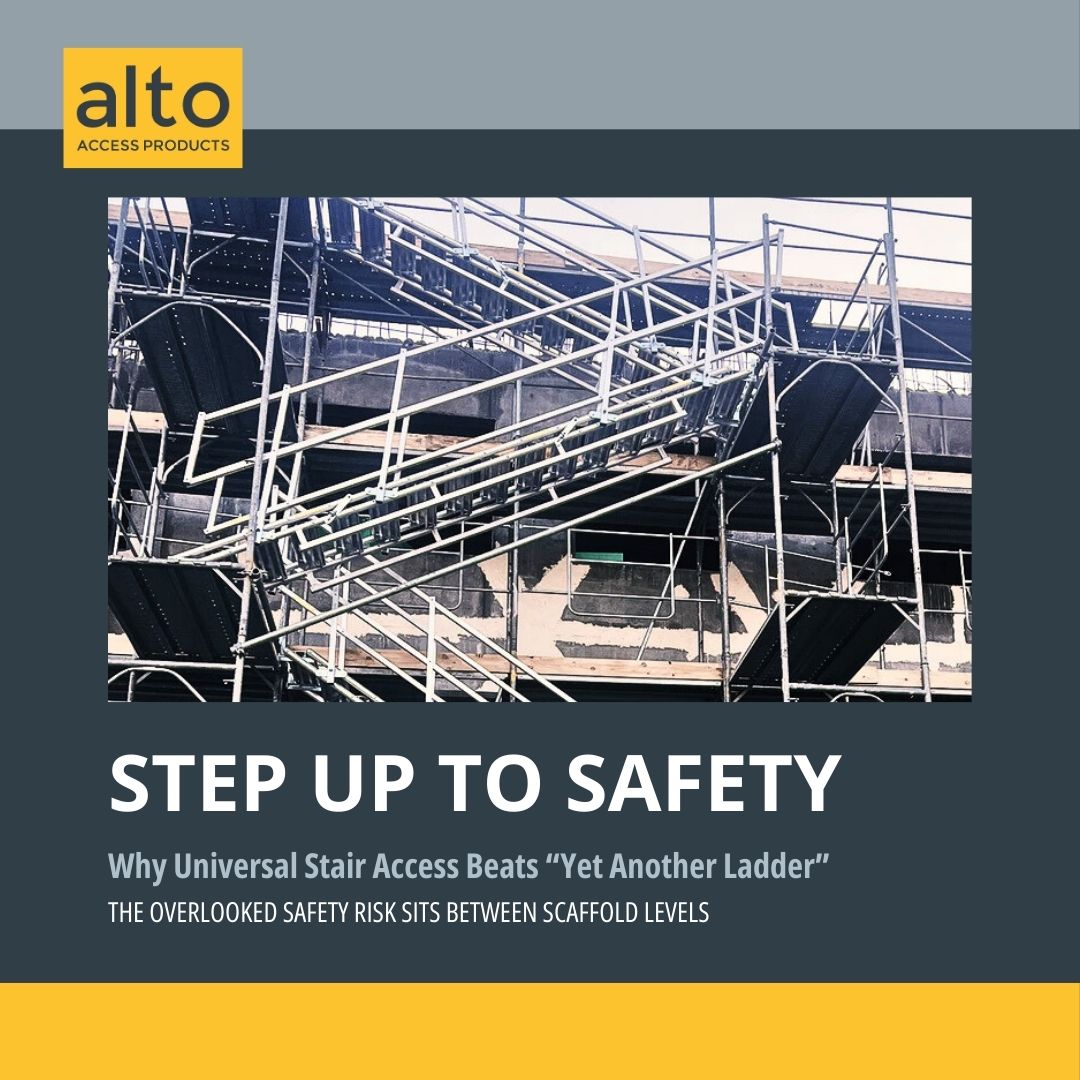
By replacing ladders with a controlled, walkable route, Universal Stairs eliminate the instability and variability associated with repeated ladder attachment, while improving material handling, traffic flow, and overall site safety.
Practical steps for adopting the Universal Stair
- Identify scaffold access points where ladders are currently used for routine or frequent movement.
- Select the appropriate Universal Stair model based on lift height.
- Install pre-assembled stairs directly onto scaffold tubes and lock securely with a spanner.
- Fit handrails using Alto proprietary or standard tube-and-fitting parts.
- Remove ladders from primary access points to reduce exposure to vertical climb hazards.
- Update risk assessments and RAMS to reflect stair adoption.
- Monitor incidents and near misses to validate improvements in safety.
Conclusion
HSE 2024/25 statistics confirm that falls from height remain a major cause of non-fatal and fatal injuries. Ladder-based scaffold access, particularly when secure attachment is variable, introduces predictable operational hazards.
The Alto Universal Stair addresses this risk directly: pre-assembled, quick to attach with a spanner, compatible with any tube-and-fitting scaffold, adaptable across six height ranges, fully BS EN 12811 compliant, and handrail-ready for safe, controlled movement. By replacing ladders for routine scaffold access, the Alto Universal Stair it helps organisations reduce exposure to height-related hazards and align operational practice with the safety trends highlighted by the HSE.